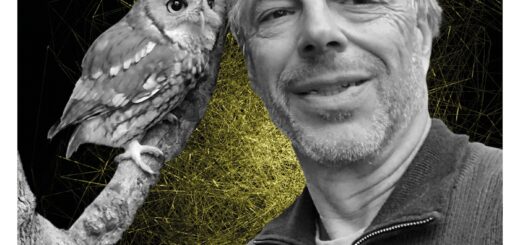
Mind is Matter: Function and Emotion with Paul Thagard
In this episode of See See by Ceci, Paul Thagard, one of the most influential thinkers at the crossroads of philosophy, psychology, and artificial intelligence, takes us on a journey through the architecture of thought, emotion, and coherence that defines the human mind.
A distinguished professor emeritus at the University of Waterloo, Fellow of the Royal Society of Canada, recipient of the Killam and Molson Prizes, and author of eighteen books, Thagard has spent decades asking the hardest questions about intelligence: what it is, where it comes from, and whether machines will ever truly share it with us. His pioneering theory of explanatory coherence reimagines the brain not as a logic machine but as a coherence engine, a system that makes sense of the world by satisfying countless constraints simultaneously, weaving perception, reasoning, and emotion into a single fabric.
In this wide-ranging conversation, Thagard reflects on the difference between intelligence and consciousness; on the devastating role of social media in the spread of misinformation; on the power of analogy as a tool of creativity, from Darwin’s theory of natural selection to the everyday act of reading a stranger’s gesture. And on why computers, despite their cognitive capacities, remain fundamentally psychopathic. “They are highly intelligent,” he says, “but they lack empathy and are therefore incapable of caring.”
That incapacity sits at the heart of the episode’s most urgent theme: the alarming rise of human-AI relationships, and what we risk losing when we mistake imitation for intimacy.
Drawing on his recent book Dreams, Jokes, and Songs: How Brains Build Consciousness and the forthcoming AI Boom or Doom?, Thagard offers a remarkably clear-eyed view of minds both human and artificial, one that is at once scientifically rigorous and deeply humane.
This is an episode about the mind as a coherence engine: hot and cold, rational and emotional, individual and social. About how neurons firing together can produce something as extraordinary as humor, as mysterious as dreams, and as dangerous as political delusion. And about the light, and the peril, that lies ahead as human and artificial intelligence continue to converge.
LINKS & INFO:
Paul Thagard, pthagard@uwaterloo.ca
Web: https://paulthagard.com
Blog: http://www.psychologytoday.com/blog/hot-thought
Academic webpage: https://uwaterloo.ca/complexity-innovation/profiles/paul-thagard
Books: paulthagard.com/books/
Others:
Mind: Introduction to Cognitive Science, by Paul Thagard, MIT Press, 1006. E.14.50 ( x + 213 pages) ISBN 0 262 20106 2
Oxford University Press has published Dreams, Jokes, and Songs https://global.oup.com/academic/product/dreams-jokes-and-songs-9780198962359
In this episode you heard as background for the Marina Viotti’s excerpt: Music: Antonio Vivaldi, “Armatae face et anguibus” from Juditha Triumphans (RV 644). Marina Viotti, mezzo-soprano; Orchestre de l’Opéra Royal; Andrés Gabetta, conductor. From the album Prime Donne (Château de Versailles Spectacles, 2026).
Most useful links for Thagard’s ECHO model:
The original 1989 paper — free PDF: https://gwern.net/doc/philosophy/epistemology/1989-thagard.pdf
Cambridge Core — the original published article: https://www.cambridge.org/core/journals/behavioral-and-brain-sciences/article/abs/explanatory-coherence/E05CB61CD64C26138E794BC601CC9D7A
PhilPapers — with commentary and citations: https://philpapers.org/rec/THAECP
1. The original 1989 PDF — the paper itself almost certainly contains a network diagram showing the ECHO constraint satisfaction model with excitatory and inhibitory links between nodes. Check directly here: https://gwern.net/doc/philosophy/epistemology/1989-thagard.pdf
2. Thagard’s own Computational Epistemology Lab — his University of Waterloo lab page has software downloads and may have visual documentation: http://cogsci.uwaterloo.ca/
3. His book Conceptual Revolutions (1992, Princeton UP) — this is where the most detailed ECHO diagrams appear, including the star/wheel diagrams showing proposition networks. It may be accessible via Google Books with partial preview.