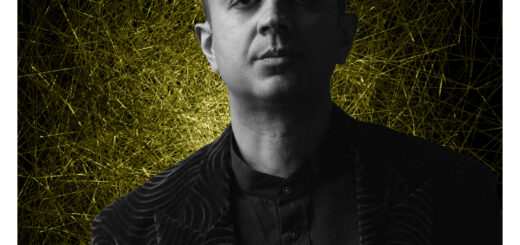
Intelligence, Immortality and AI with Stephen J. Cave
In this episode of See See by Ceci, Dr Stephen Cave, philosopher of technology, intelligence and the human quest to outlive death, joins us in our Berlin studio. At heart, this episode turns on two questions most of us would sooner leave undisturbed: why do human beings insist on ranking one another, and why can we not make our peace with the fact that we die?
Academic Director of the Leverhulme Centre for the Future of Intelligence and Co-Director of the Institute for Technology and Humanity, both at the University of Cambridge, Dr Cave took his PhD in philosophy at Cambridge before spending the better part of a decade as a British Foreign Office diplomat. He is the author of Immortality: The Quest to Live Forever and How It Drives Civilization, a New Scientist Book of the Year, and, with the philosopher John Martin Fischer, Should You Choose to Live Forever?: A Debate. He is also co-editor of AI Narratives, Imagining AI and Feminist AI, all published by Oxford University Press.
In this wide-ranging conversation, Dr Cave traces the idea of “intelligence” across two and a half thousand years, from Aristotle’s “natural slaves” to Francis Galton’s invention of both eugenics and the IQ test, showing how so slender a concept came to serve as the perfect instrument for justifying patriarchy, colonialism and scientific racism. It is precisely this buried history, he argues, that explains the dread super-intelligent machines now inspire in us. The real peril, he suggests, lies not in what artificial intelligence might do to us, but in the deep-seated biases and failings already entrenched our societies, that is, in what we might be tempted to do to one another with it: in surveillance, in the automation of labour, and, above all, in the quiet erosion of the human relationships that hold a society together and lend our lives their meaning.
He then turns to mortality: the four stories every civilisation tells itself to outwit death, why a genuine immortality would prove a curse rather than a gift, and how our very finitude is the thing that makes a life worth living. From the Epic of Gilgamesh to Borges’s deathless troglodytes, from Dorian Gray to the laboratories where great fortunes are now spent in pursuit of longer life, he asks what such a life is truly worth if it is not also a life of meaning, and warns that “work, scroll, repeat” is no less hollow at two hundred than at eighty.
He arrives, in the end, at something disarmingly simple: an answer that has rather less to do with intelligence than we might expect, and everything to do with finitude, and with what, and whom, a life is spent upon.
With reflections from the philosopher and cognitive scientist Paul Thagard on whether a machine can ever truly care; from the posthumanist scholar N. Katherine Hayles on the human aura in the age of the deep fake and the promised revision of the Enlightenment; from the drummer, composer and Berklee professor Terri Lyne Carrington on music and the eternal present; from the historian Philip Matyszak on the Roman afterlife and the building of “moral muscles”; and from the cognitive neuropsychologist Alfonso Caramazza on the remarkable flexibility of the human mind.
This is an episode about power and the stories it tells to justify itself; about the older stories we tell to cheat death; and about a quiet, radical proposition: that to be human is not to be the cleverest thing in the room, but to know that our days are numbered, and to spend them building and delighting in our bonds with one another.
LINKS & INFORMATION:
Website: https://www.lcfi.ac.uk/people/stephen-cave
X (Twitter): https://x.com/stephenjcave @stephenjcave
TED speaker: https://www.ted.com/speakers/stephen_cave
BOOKS:
Immortality: The Quest to Live Forever and How It Drives Civilization (Crown, 2012), a New Scientist book of the year:
https://penguinrandomhousehighereducation.com/book/?isbn=9780307884916
Should You Choose to Live Forever? A Debate, with John Martin Fischer (Routledge, 2023):
https://www.routledge.com/Should-You-Choose-to-Live-Forever-A-Debate/Fischer-Cave/p/book/9780367343897
AI Narratives: A History of Imaginative Thinking about Intelligent Machines, co-edited with Kanta Dihal and Sarah Dillon (Oxford University Press, 2020):
https://global.oup.com/academic/product/ai-narratives-9780198846666
Imagining AI: How the World Sees Intelligent Machines, co-edited with Kanta Dihal (Oxford University Press, 2023):
https://global.oup.com/academic/product/imagining-ai-9780192865366
Feminist AI, co-edited (Oxford University Press, 2023):
https://global.oup.com/academic/product/feminist-ai-9780192889898
Recommended Articles:
Stephen Cave, “Intelligence: A History” (also published under the title “On the dark history of intelligence as domination”), Aeon, 2017.
https://aeon.co/essays/on-the-dark-history-of-intelligence-as-domination
The academic paper (peer-reviewed, fuller and more technical):
Stephen Cave, “The Problem with Intelligence: Its Value-Laden History and the Future of AI,” Proceedings of the AAAI/ACM Conference on AI, Ethics, and Society, 2020.
https://dl.acm.org/doi/10.1145/3375627.3375813